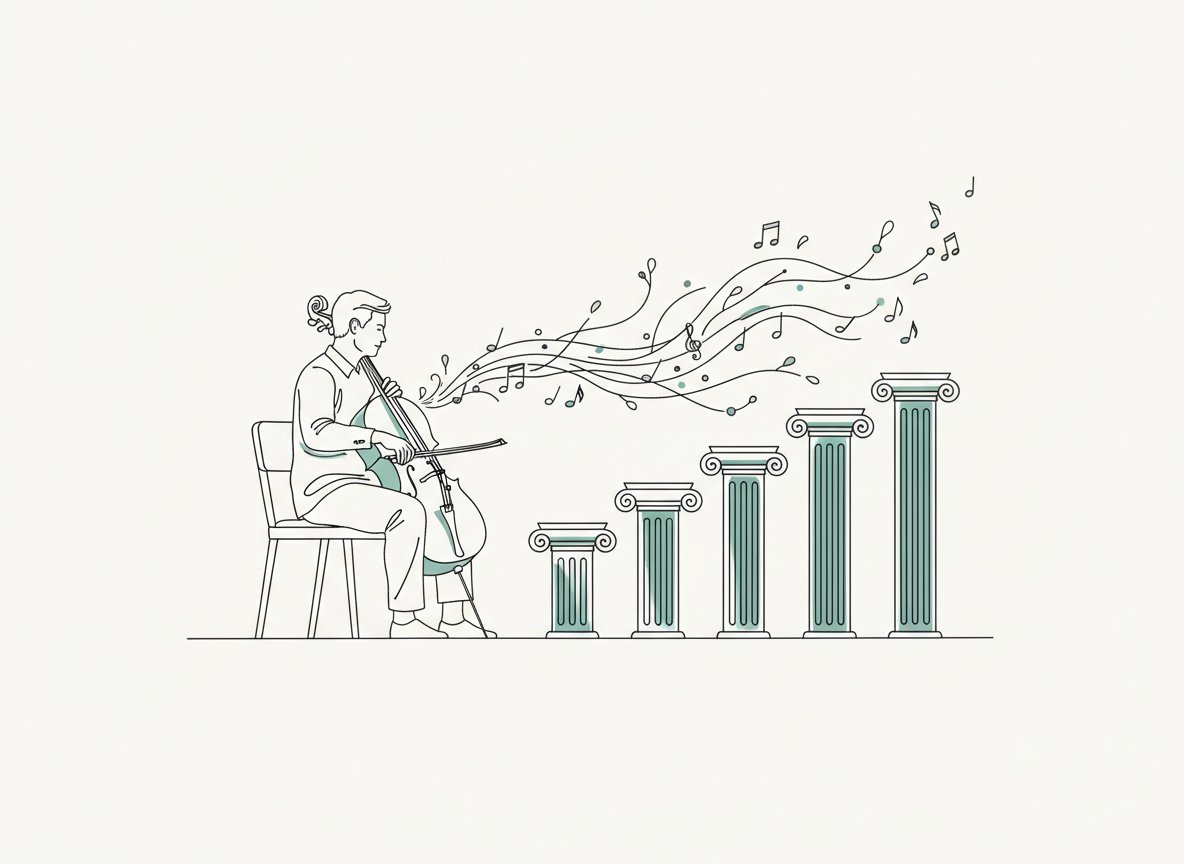
We often think of music as something we consume—a soundtrack playing in the background of our commute, our workouts, or our quiet evenings at home. Listening to music is undeniably powerful, capable of shifting our mood in seconds.
However, when you cross the threshold from passive listener to active creator, something extraordinary happens inside your brain, body, and spirit (Wan & Schlaug, 2010; Herholz & Zatorre, 2012).
“When jarred, unavoidably, by circumstances, revert at once to yourself, and don’t lose the rhythm more than you can help. You’ll have a better grasp of the harmony if you keep on going back to it.”
— Marcus Aurelius, Meditations (6.11)
We explore how intentional daily practices ripple across the whole person. Few disciplines unite mind, body, and community as completely as picking up a musical instrument. Yet, two common myths hold people back: “I’m too old to start now,” and “I don’t have natural talent.”
Both modern neuroscience and ancient Stoic philosophy tell a very different story. Whether you are seven or seventy, and whether you are awkwardly pressing your very first piano key or refining a complex classical piece, the act of making music is one of the most transformative investments you can make for lifelong cognitive and emotional vitality (Wan & Schlaug, 2010; Vetere et al., 2024).
Music Through the Lens of the Four Pillars of Holistic Health
To understand why learning an instrument is such a potent catalyst for personal renewal, let’s look at how empirical research shows it nourishes all four core pillars of holistic health:
1. Mental Health: The Ultimate Full-Brain Workout
When neuroscientists observe the brains of people playing an instrument using functional neuroimaging, they don’t just see one isolated region light up—they see a coordinated network of activity across the entire cortex (Wan & Schlaug, 2010; Herholz & Zatorre, 2012). Reading notation or chord charts, feeling the tactile feedback of strings or keys, listening to pitch, and keeping rhythm simultaneously engages and strengthens the visual, auditory, and motor cortices.
“People look for retreats for themselves, in the country, by the coast, or in the hills… There is nowhere that a person can find a more peaceful and trouble-free retreat than in his own mind.”
— Marcus Aurelius, Meditations (4.3)
- Emotional Regulation & Neurochemical Balance: Engaging with music modulates major neurochemical systems in the brain—lowering levels of cortisol and adrenocorticotropic hormone (markers of the stress response) while stimulating dopamine, serotonin, and endogenous opioid peptides associated with reward and pleasure (Chanda & Levitin, 2013).
- The “Flow State” as an Inner Sanctuary: As Marcus Aurelius reminded himself, true peace requires cultivating an inner retreat. For those who find silent meditation difficult, practicing an instrument demands present-moment focus, training attention inhibition and cognitive switching (Rogers & Metzler-Baddeley, 2024).
2. Physical Health: Fine-Tuned Body Awareness
Music is an inherently physical discipline that bridges the gap between mental intention and bodily execution. The Stoic philosopher Musonius Rufus emphasized that true human flourishing requires training the mind and the physical body in tandem:
“Since a human being happens to be neither soul alone nor body alone, but a synthesis of the two, a person in training must pay attention to both.”
— Musonius Rufus, Lectures (6, On Training)
- Bilateral Coordination & Structural Brain Changes: Instruments like the piano, drums, and guitar require both hands to perform independent actions simultaneously. Longitudinal and structural neuroimaging studies demonstrate that instrumental music training induces macroscopic and microscopic changes in the corpus callosum—the white-matter bridge connecting the left and right hemispheres of the brain—as well as the primary motor cortex (Wan & Schlaug, 2010; Habibi et al., 2017).
- Sensorimotor Synchronization & Autonomic Regulation: Repeatedly associating fine motor actions with continuous auditory and visual feedback strengthens sensorimotor integration pathways (Herholz & Zatorre, 2012) while regulating autonomic arousal (Chanda & Levitin, 2013).
3. Societal Health: Connection Beyond Words
In an era of digital fatigue and growing isolation, music remains one of humanity’s oldest bonding languages. Writing to his friend Lucilius, the Stoic statesman Seneca used a musical ensemble as the ultimate metaphor for a harmonious life and society:
“Look at how many voices make up a choir, yet out of all of them comes a single harmony. Some are high, some are low, some are in the middle; women’s voices join with men’s, and flutes are interspersed among them. The individual voices are hidden; what we hear is all of them together.”
— Seneca, Letters from a Stoic (Letter 84)
- Neurohormonal Social Bonding: Evolutionary and social neuroscience research shows that making music in groups triggers two powerful bonding mechanisms: interpersonal synchrony (“self-other merging” via shared action-perception networks) and the release of neurohormones, including oxytocin and endorphins via the endogenous opioid system (Chanda & Levitin, 2013; Tarr et al., 2014).
- Community & Intergenerational Well-Being: Participating in group music sessions enhances both psychological well-being and cognitive function in older adults, counteracting social isolation (Shinada et al., 2025).
4. Financial Health: Cognitive Longevity and Mindful Value
While we rarely associate a guitar or keyboard with financial wellness, the return on investment (ROI) of musical training is profound when we examine how we steward our time and long-term cognitive capital.
“It is not that we have a short time to live, but that we waste a lot of it. Life is long enough, and a sufficiently generous amount has been given to us for the highest achievements if it were all well invested.”
— Seneca, On the Shortness of Life (1.3)
- Protecting Your Greatest Asset—Cognitive Reserve: Executive functioning, working memory, and processing speed are vital for independent decision-making, career longevity, and daily functioning (Rogers & Metzler-Baddeley, 2024). Large-scale cohort analyses show that playing a musical instrument builds lifelong cognitive reserve, significantly improving working memory and executive trajectories in later adulthood and helping protect against mild cognitive impairment and dementia (Vetere et al., 2024; Hanna-Pladdy & MacKay, 2011).
- High-Value, Low-Consumption Fulfillment: Once you acquire an entry-level instrument, it provides thousands of hours of restorative enrichment. Shifting leisure time from passive consumption to active skill-building cultivates patience, delayed gratification, and financial mindfulness.
A Lifelong Instrument: Benefits Across Every Age Group
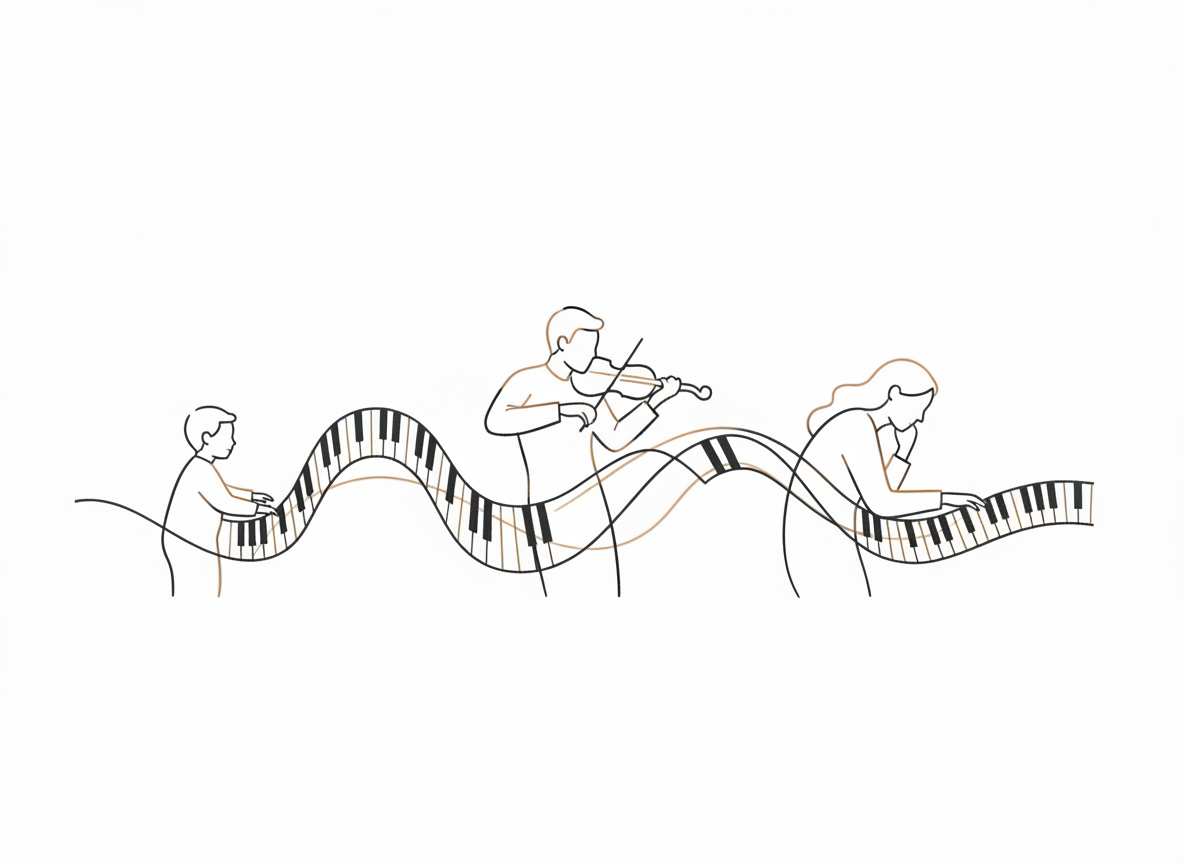
There is no “expiration date” on neuroplasticity—the brain’s capacity to modify its structural and functional organization across the entire life span in response to skill learning (Wan & Schlaug, 2010).
| Life Stage | Core Developmental Focus | Key Evidence-Based Holistic Benefits |
| Children & Teens | Foundation & Identity | Induces macro- and microstructural changes in auditory and motor brain regions and the corpus callosum, independent of pre-existing biological traits (Habibi et al., 2017). |
| Young Adults & Students | Focus & Emotional Balance | Regulates stress neurochemistry (cortisol and dopamine) and strengthens multimodal integration networks across visual, auditory, and motor systems (Chanda & Levitin, 2013; Wan & Schlaug, 2010). |
| Working Professionals & Parents | Renewal & Stress Mastery | Preserves fluid intelligence, attention switching, and working memory while fostering prosocial bonding through shared family and community music-making (Tarr et al., 2014; Vetere et al., 2024). |
| Retirees & Seniors | Cognitive Vitality & Legacy | Enhances executive function, processing speed, nonverbal memory recall, and word retrieval, building protective cognitive reserve against age-related decline (Bugos et al., 2007; Hanna-Pladdy & MacKay, 2011; Rogers & Metzler-Baddeley, 2024). |
Special Spotlight: The Power of Midlife and “Third Age” Learning
Many adults past forty assume their window for learning an instrument has closed. In truth, empirical studies confirm that initiating musical instrument training in midlife or older adulthood actively counteracts age-related cognitive decline (Bugos et al., 2007; Rogers & Metzler-Baddeley, 2024). In a landmark randomized controlled trial of older adults aged 60 to 85 who had never played an instrument, just six months of individualized piano instruction produced significant improvements in executive functioning, working memory, and perceptual processing speed compared to controls (Bugos et al., 2007). Furthermore, analysis of the UK PROTECT aging cohort (adults over 40) confirmed that playing an instrument—particularly keyboard and woodwind instruments—is associated with superior working memory and executive function trajectories (Vetere et al., 2024).
When Seneca was in his sixties, he began attending philosophy lectures alongside young students. Responding to critics who thought he was too old to sit in a classroom, he wrote:
“As long as you live, keep learning how to live… What is more foolish than refusing to learn simply because you have not been learning for a long time?”
— Seneca, Letters from a Stoic (Letter 76)
Stepping into the role of a student after years of being the “expert” in your career or household refreshes the spirit, humbles the ego, and sparks profound personal renewal.
Why Competency Doesn’t Matter: Every Stage Has Its Own Magic
One of the greatest traps in modern culture is believing that if we aren’t “good” at something—or can’t monetize it—it isn’t worth doing. When it comes to holistic health, the biological and spiritual benefits of music happen during the process, not just the performance (Herholz & Zatorre, 2012).
1. The Absolute Beginner: The Magic of “Beginner’s Mind”
Who you are: You are learning where the notes are, figuring out how to hold the instrument, and celebrating your first clean scale or three-chord progression.
“It is impossible for a man to learn what he thinks he already knows.”
— Epictetus, Discourses (2.17.1)
- Why this stage is powerful: Neuroplastic reorganization is triggered precisely when the brain is challenged to acquire novel sensorimotor associations (Herholz & Zatorre, 2012; Bugos et al., 2007). Struggling to coordinate your fingers on a new chord forces your brain to build brand-new connections between auditory and motor regions (Wan & Schlaug, 2010). Embracing the awkwardness of being a novice strips away ego and builds psychological resilience.
2. The Developing Intermediate: The Art of Flow and Patience
Who you are: You have the basics down. You can play recognizable songs, read music or tabs with growing confidence, and are beginning to add personal expression and dynamics.
“No great thing is created suddenly, any more than a bunch of grapes or a fig. If you tell me that you desire a fig, I answer you that there must be time. Let it first blossom, then bear fruit, then ripen.”
— Epictetus, Discourses (1.15.7)
- Why this stage is powerful: Here, music becomes a reliable sanctuary. Amateur musicians exhibit significant structural gray matter enhancements compared to non-musicians, proving you do not need to be a professional virtuoso to physically reshape your brain (Wan & Schlaug, 2010). Navigating intermediate plateaus teaches the Stoic virtue of patience—showing how consistent daily habits compound over time.
3. The Advanced Player & Lifelong Master: Stewardship and Transcendence
Who you are: The instrument feels like a natural extension of your voice. You understand theory, nuance, improvisation, or complex repertoire.
“What then is it that brings a soul to perfection? The knowledge of what is in harmony with its own nature.”
— Seneca, Letters from a Stoic (Letter 41)
- Why this stage is powerful: Neuropsychological research shows a strong predictive relationship between high lifetime musical engagement (10+ years) and preserved nonverbal memory, naming, and executive processes in advanced age (Hanna-Pladdy & MacKay, 2011). At advanced levels, playing also becomes an act of community stewardship that uplifts the societal health of everyone around you (Tarr et al., 2014).
Four Practical Tips to Begin (or Rekindle) Your Musical Journey Today
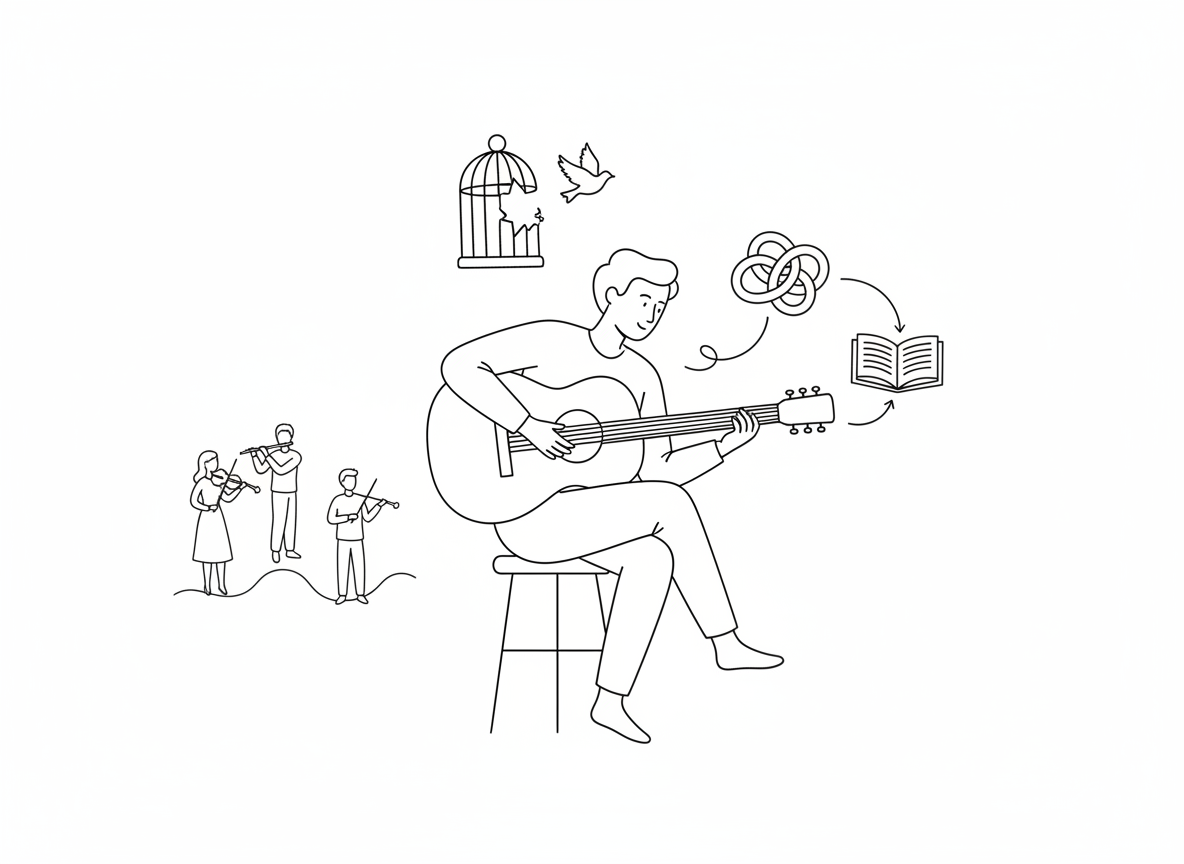
- Choose the Instrument That Speaks to You: Whether it is the versatility of the piano, the warmth of acoustic strings, or the breath-work of woodwinds, choose an instrument that sparks intrinsic joy (Vetere et al., 2024).
- Embrace Consistent Daily Practice: Neuroplasticity thrives on regular, repeated sensorimotor feedback rather than sporadic marathons (Wan & Schlaug, 2010; Herholz & Zatorre, 2012).
- Invest in Guided Instruction & Group Play: Structured instruction accelerates executive function gains (Bugos et al., 2007), while group sessions amplify social bonding and psychological well-being (Tarr et al., 2014; Shinada et al., 2025).
- Release the Critic: Give yourself permission to make wrong notes. Every missed note is simply auditory-motor feedback your brain uses to calibrate the next attempt (Herholz & Zatorre, 2012).
Join the Conversation
Music reminds us that harmony isn’t created by playing a single note forever—it is created by movement, tension, resolution, and growth. No matter where you are on your life’s timeline, your next chapter deserves a soundtrack that you help create.
We’d love to hear from our HSL Community in the comments below:
- Which of the Stoic reflections or scientific findings above resonates most with where you are in your personal growth right now?
- If you could start learning—or return to—any instrument today with zero fear of judgment, which one would you choose?
References
Bugos, J. A., Perlstein, W. M., McCrae, C. S., Brophy, T. S., & Bedenbaugh, P. H. (2007). Individualized Piano Instruction enhances executive functioning and working memory in older adults. Aging & Mental Health, 11, 464–471. https://doi.org/10.1080/13607860601086504
Cited by: 721
Chanda, M. L., & Levitin, D. J. (2013). The neurochemistry of music. Trends in Cognitive Sciences, 17, 179–193. https://doi.org/10.1016/j.tics.2013.02.007
Cited by: 1990
Habibi, A., Damasio, A., Ilari, B., et al. (2017). Childhood Music Training Induces Change in Micro and Macroscopic Brain Structure: Results from a Longitudinal Study. Cerebral Cortex, 28, 4336–4347. https://doi.org/10.1093/cercor/bhx286
Cited by: 238
Hanna-Pladdy, B., & MacKay, A. (2011). The relation between instrumental musical activity and cognitive aging. Neuropsychology, 25, 378–386. https://doi.org/10.1037/a0021895
Cited by: 541
Herholz, S. C., & Zatorre, R. J. (2012). Musical Training as a Framework for Brain Plasticity: Behavior, Function, and Structure. Neuron, 76, 486–502. https://doi.org/10.1016/j.neuron.2012.10.011
Cited by: 1263
Rogers, F., & Metzler-Baddeley, C. (2024). The effects of musical instrument training on fluid intelligence and executive functions in healthy older adults: A systematic review and meta-analysis. Brain and Cognition, 175, 106137. https://doi.org/10.1016/j.bandc.2024.106137
Cited by: 34
Shinada, T., Takahashi, M., Uno, A., Soga, K., & Taki, Y. (2025). Effects of group music sessions on cognitive and psychological functions in healthy older adults. Frontiers in Aging, 6. https://doi.org/10.3389/fragi.2025.1513359
Cited by: 9
Tarr, B., Launay, J., & Dunbar, R. I. M. (2014). Music and social bonding: “self-other” merging and neurohormonal mechanisms. Frontiers in Psychology, 5. https://doi.org/10.3389/fpsyg.2014.01096
Cited by: 900
Vetere, G., Williams, G., Ballard, C., et al. (2024). The relationship between playing musical instruments and cognitive trajectories: Analysis from a UK ageing cohort. International Journal of Geriatric Psychiatry, 39. https://doi.org/10.1002/gps.6061
Cited by: 41
Wan, C. Y., & Schlaug, G. (2010). Music Making as a Tool for Promoting Brain Plasticity across the Life Span. The Neuroscientist, 16, 566–577. https://doi.org/10.1177/1073858410377805
Cited by: 928


Leave a Reply