Why the Four Pillars Fall Together
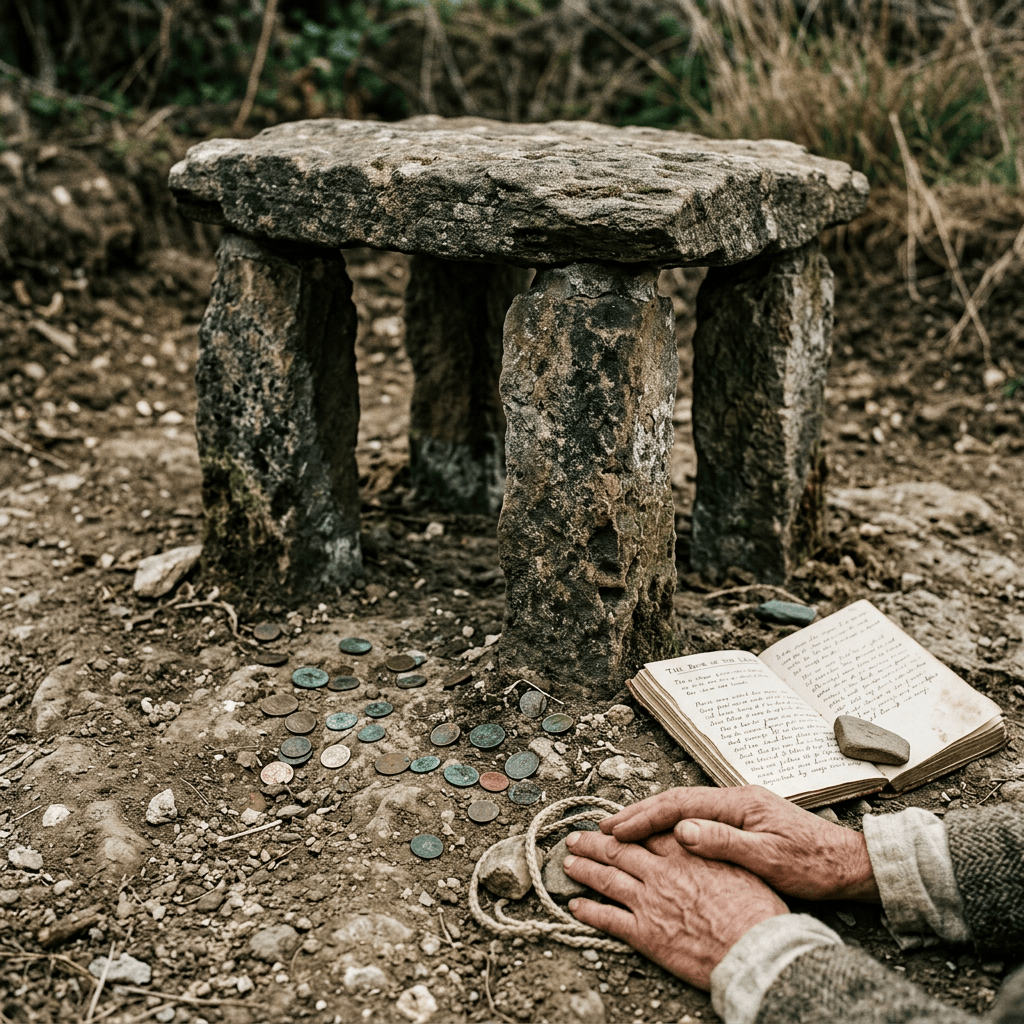
A table with three legs is, on uneven ground, more stable than one with four. Remove a leg and it settles; add a leg and it wobbles, searching for a surface that does not exist. Yet we keep building our lives as if they were four-legged tables, convinced that if we could just shore up every side at once, the structure would finally hold. It does not. When one pillar bears too much weight, the others do not simply stand by; they begin to lean, to warp, to take on shapes we did not intend.

The Architecture of a Life
At HSL, we speak of four pillars: Finance, Society, Mind, and Body. The metaphor is imperfect, as all metaphors are, but it is useful if we resist the urge to turn it into a checklist. A life is not a row of boxes awaiting their ticks. It is an architecture of forces and constraints, of supports and openings, of visible beams and hidden foundations. What looks stable from one angle may be precarious when you walk around it.
Aristotle wrote of eudaimonia, the kind of flourishing that cannot be reduced to pleasure or achievement. It requires a certain coherence: how one earns, how one loves, how one thinks, how one cares for the body. Confucian thought, in its attention to harmony across roles — child, friend, citizen, ruler — understood that imbalance in a single relation distorts the whole pattern. Contemporary research only reiterates what earlier centuries intuited. Gallup’s studies of wellbeing, with their multiple domains, and Harvard’s long-running Study of Adult Development converge on a simple observation: no single sphere of life, however gilded, can sustain a person indefinitely. A strong career cannot redeem chronic loneliness; a luminous inner life cannot indefinitely compensate for neglected health.
To speak of pillars, then, is not to isolate compartments but to notice interdependence. Change the load on one and the others shift, whether we wish them to or not. The work is not to perfect each pillar in turn, but to cultivate the capacity to sense where the structure is quietly straining.
“The flourishing life is not assembled from its best parts. It is grown, the way a forest grows — each element dependent on the conditions the others create.”
Finance: The Forgotten Pillar
Of the four, Finance is the pillar many are most reluctant to view as spiritual, or even as worthy of sustained reflection. Money feels crude beside subtler aspirations. Yet economic anxiety has its own metaphysics: it compresses the psyche, narrows the sense of the possible, and turns other people into either competitors or saviors. Under chronic financial strain, social life shrinks to transactions, the body tightens into vigilance, and the mind begins to orbit the same small set of fears. One can meditate for hours and still be undone by the sudden arrival of an unpaid bill.
But surplus, when it arrives without purpose, is hardly more liberating. Kahneman and Killingsworth’s debates about income and wellbeing — whether happiness plateaus after a certain point or continues to rise — sometimes obscure a simpler question: what is the money for. The Stoics spoke of “preferred indifferents” — health, status, wealth — conditions that could be sensibly chosen without being mistaken for the good itself. Finance, in this view, is best approached as sufficiency rather than accumulation: enough to loosen the psychic vise, to enable generosity and choice, without allowing the pursuit itself to become a quiet tyranny. This is not abstinence from ambition, but a redefinition of what counts as “enough.”

Society: The Invisible Architecture
We are social in ways that reach beyond dinner parties and messaging threads. Our nervous systems are porous; heart rates sync in conversation, stress hormones rise and fall in response to subtle cues from others. Isolation is not simply the absence of company but a physiological event, and over time it erodes cognition as surely as it erodes mood. Studies on loneliness show declines in memory, attention, and even immune function. By contrast, modest but reliable belonging — a standing invitation, a neighbor who notices, a community that expects you — acts as a kind of distributed mind, catching what you can no longer hold alone.
Still, not all connection nourishes. The fact that Dunbar’s number posits an approximate cognitive limit to stable relationships does not tell us which of those relationships are worth the limited space. The Harvard Study of Adult Development, after decades of tracking lives, found that the quality of close relationships is the most powerful predictor of late-life health, more than cholesterol, more than career success. Confucian thought names one aspirational thread running through these ties: jen, often translated as benevolent humaneness. Crucially, it is framed not as a feeling but as a practice — enacted through small, steady gestures rather than grand declarations. The social pillar is built less from dramatic connections than from the quiet architecture of who we allow to shape us, and whom we are willing to be shaped by.

Mind: The Pillar That Holds the Others Upright
Of the four pillars, Mind is the least visible and perhaps the most decisive. Finances can crash, bodies can falter, relationships can fray, but the mind is the medium in which we interpret all of it. Its deterioration is rarely sudden. It appears as a subtle narrowing: fewer questions, quicker certainties, a growing impatience with complexity. Left unattended, the mind tends to close in on itself, reinforcing the very patterns that keep us confined.
Philosophy, contemplative practice, and sustained intellectual engagement are often treated as luxuries, pursuits for when the “real” problems are solved. Yet research on cognitive reserve suggests that a mind regularly stretched — through reading, dialogue, learning, sustained attention — is more resilient against decline. Viktor Frankl, writing out of extremity, observed that meaning-making is not a decorative layer added after the fact, but a precondition for enduring what cannot be quickly changed. The pillar of Mind, then, is not about abstract cleverness. It is about tending the faculty that weaves experience into a coherent story, that can hold paradox without rushing to resolution, and that can choose responses more thoughtfully than simple reflex allows.

Body: What the Body Knows
The modern imagination often treats the body as a vehicle for the mind, a kind of transport and maintenance problem. Feed it, move it, and hope it does not interrupt more interesting pursuits. Yet the boundary between body and mind is much more porous. Interoception — the capacity to sense internal states like heartbeat, breath, tension, and temperature — shapes not just emotional regulation but also memory, judgment, and empathy. A mind that cannot feel its own body clearly will misread other people as well, confusing its own unregistered fatigue or fear with flaws in the world outside.
The pillar of Body does not demand optimization. It asks for listening that is both precise and unheroic. Not every ache is a crisis, and not every surge of energy is a command to sprint. But chronic neglect dulls perception: sleep debt blurs moral insight as well as reaction time; nutritional chaos fogs attention; a day without movement leaves the world feeling narrower than it is. Attending to the body is therefore less about chasing peak performance and more about preserving the basic clarity needed to notice what is actually happening in one’s life.

Work and Recreation: The Tension at the Center
At the center of these four pillars lies a tension that most of us feel but rarely examine: the relationship between work and recreation. It is tempting to cast them as opposites, enemies in a perpetual zero-sum struggle for hours and attention. Yet they are better understood as a polarity, and polarities require management rather than victory. Aristotle’s notion of leisure, scholē, was not the mere absence of labor but its purpose — a space for learning, reflection, and the cultivation of character. We work, in this view, to secure the conditions for genuine leisure, which is itself a kind of serious play. Industrial capitalism inverted this hierarchy, sanctifying productivity as virtue and recasting rest as, at best, recovery and, at worst, laziness. Under this regime, even leisure is asked to justify itself in terms of future output.
The contemporary evidence is unambiguous enough to be almost embarrassing. Chronic overwork erodes the very capacities that workplaces claim to prize: sustained attention, originality, ethical discernment. Decision-making becomes brittle, empathy thins, errors multiply. Leisure psychology’s DRAMMA model names six mechanisms through which recreation restores wellbeing: Detachment, Relaxation, Autonomy, Mastery, Meaning, and Affiliation. Not all leisure activities touch all six. Passive consumption — scrolling, binge-watching, vague drifting across tabs — can provide brief detachment and a measure of relaxation, but it rarely confers mastery or meaning, and its affiliation is often illusory. By contrast, active, engaged forms of recreation — tending a small garden, playing an instrument badly but earnestly, walking with a friend, experimenting in the kitchen, learning a craft — weave together autonomy, mastery, and affiliation in ways that subtly rebuild a frayed self.
There is also a quieter dimension to this polarity, one that touches the question of what we take a self to be. When recreation is treated as reward, it becomes conditional, something to be granted only when sufficient labor has been performed. But there is a more elemental view: that periods of non-instrumental activity are the conditions under which the self slowly reconstitutes itself. A self that never reconstitutes cannot sustain demanding work, yes, but it also cannot sustain intimacy, curiosity, or moral clarity. Across traditions, the Sabbath principle — whether in the Jewish week, Islamic rest practices, Christian Sunday, or periodic Buddhist retreat — encodes this recognition: regular interruption is not a decorative religious add-on but an anthropological concession to how minds and bodies actually function over time.

Balance between work and recreation, then, will rarely look like an even split. There will be seasons of intensification and seasons of loosened grip. The more important question is not the numerical ratio but the degree of awareness and consent involved. Are we choosing the current tilt, or merely being carried by habit, fear, or expectation. Work, approached without reflection, quietly colonizes identity until the question “Who are you” elicits only a job description. Recreation, approached as mere escape, becomes a blur of forgetting rather than a space of real restoration. To inhabit a human life is to move back and forth between these modes with some deliberateness, willing both to contribute and to pause, to exert and to play, and to recognize that neither side has the final word on who we are.
“We do not rest to earn more work. We rest because a life that cannot pause cannot think — and a life that cannot think cannot choose.”
Practicing Equilibrium
If all this remains at the level of insight, it becomes another elegant framework admired from a distance. The architecture of a life is changed by minor, unglamorous adjustments. One such practice is a quarterly audit across the four pillars — not a journaling exercise in which one describes feelings about balance, but a sober inventory of where the weight is actually landing. Which pillar is currently carrying most of the load. Is that sustainable. What is being quietly mortgaged in the process. From this vantage point, the idea of “minimum viable engagement” becomes useful: during seasons when one pillar legitimately must bear more weight, what is the smallest, most concrete action that keeps the others from collapsing altogether.

Equally practical is learning to distinguish between restoration and avoidance in one’s recreational life. The same activity — an evening walk, a book, a drink with friends — can serve either function, depending on intention and aftereffect. Research on creativity suggests that deliberately scheduling unstructured time, free from both work goals and elaborate leisure plans, yields more genuine insight than filling every gap with structured improvement. Finally, the practice of scanning for accumulating deficits in each pillar before they become crises allows for earlier, less dramatic course corrections: noticing the stiffening resentment toward work before it explodes, the thinning of social contact before isolation hardens, the subtle numbing of the body before illness forces attention, the dulling of curiosity before the mind concludes that nothing new is worth learning.
In the end, the wisest path through a human life is rarely a straight one. Real balance looks less like symmetrical perfection and more like a seasoned walker on uneven ground — shifting weight, adjusting stride, attending closely to each new patch of earth. There is no point at which the walking is finished and the view is permanently secured. There is only the next step, and the next small decision about where to place one’s weight.
A Note from HSL
To our readers and fellow travelers — you may have noticed our two-week absence from the Journal. We were on the road.
From late August through the first days of September, the HSL team conducted our Maryland Health Fair Tour, spanning six counties and engaging directly with more than 6,000 attendees. County by county, conversation by conversation, we shared the four-pillar framework, distributed resources on conscious living, and listened — perhaps most importantly — to the questions and stories people carry when they meet the intersection of health, spirit, and everyday life.
It was a reminder that this work does not live only on a page. It lives in gymnasiums and community centers, in the hands of a grandmother asking about stress and sleep, in the eyes of a teenager hearing for the first time that the mind is a pillar worth tending.
We return to the Journal renewed, and with much to write about. Thank you for your patience, and for being here.
— The HSL Organization | Maryland Health Fair Tour, August–September 2026
The Wisest Path is an ongoing series exploring the integration of spiritual intelligence across the four pillars of HSL: Finance, Society, Mind, and Body.


Leave a comment