
The Body Remembers Water
Water is not a supplement. It is the condition everything else depends on.
The Body Remembers Water
On elemental thirst, cognitive cost, and the quiet inequity beneath every glass of water.
Water does not announce itself. It is the medium through which the body thinks, mourns, decides, and repairs — and it asks for almost nothing in return except that you remember it exists. Most of the time, you don’t. You reach for coffee, for tea, for something with flavor and intention behind it, and water waits. Transparent. Patient. Faintly embarrassed by its own adequacy.
There is something almost philosophically unsettling about water’s necessity. It comprises roughly sixty percent of the adult body — the interior ocean that Hippocrates intuited and molecular biology later mapped in humbling detail — and yet it is among the first things we neglect when life becomes full. We track macronutrients, optimize sleep schedules, negotiate with our calendars, and forget to drink. The oversight is so common it has ceased to seem like an oversight at all.
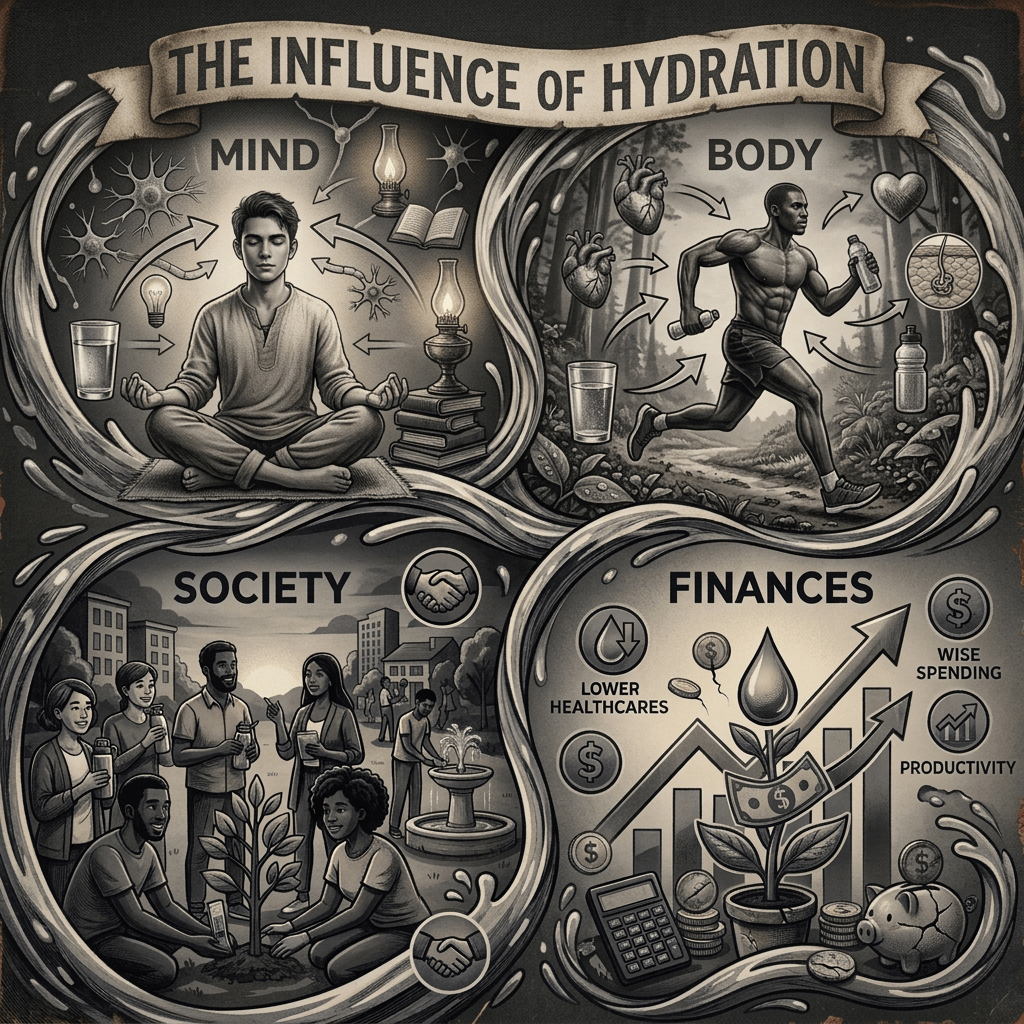
What follows is not a reminder to drink more water. It is something more uncomfortable than that: an examination of what dehydration actually costs — cognitively, emotionally, economically, and socially — and why that cost is not distributed evenly. Water, it turns out, is one of the more honest lenses through which to look at the four domains HSL takes seriously: Body, Mind, Finance, and Society. Each pillar catches the light differently. Each reveals something the others cannot.
Body: The Curvilinear Truth

The body is not a simple machine, and dehydration is not simply the absence of enough water. This is worth stating plainly because the conventional framing
— drink eight glasses, stay hydrated, feel better — papers over a more interesting and less comfortable reality. A 2024 study drawing on NHANES data, published in the Journal of Nutrition in Gerontology and Geriatrics, found a curvilinear relationship between hydration status and executive function: performance suffered not only when people were under-hydrated, but also when they were over-hydrated. The body, it seems, tolerates neither deprivation nor excess with equanimity. It wants precision, and it will exact a cognitive tax for imprecision in either direction.[1]
That executive function — the cluster of higher-order processes that governs planning, flexible thinking, and the suppression of impulse — is among the first faculties compromised. A 2024 randomized controlled trial using multimodal MRI imaging demonstrated measurable changes in brain structure and cognitive performance after just twelve hours of water restriction. Twelve hours. The span of an ordinary workday. The distance between dinner and lunch. Most people reading this have, without realizing it, subjected their brains to that interval of restriction more times than they can count.[2]
Even what researchers classify as mild dehydration — a loss of one to two percent of body mass — is sufficient to produce sustained attention failures, particularly in middle-to-older adults. A 2025 study in Physiology and Behavior traced increased afternoon dehydration in schoolchildren to worse performance on memory-related tasks and measurably lower mood. The afternoon slump, which modern culture has addressed with espresso and ambient workplace noise, may have a simpler, more foundational explanation. What the body needs is not stimulation. It needs water.[3]
None of this is to suggest that hydration is a cure or a protocol. The body is too complex for that kind of clean causality. But there is something worth sitting with here: the most basic maintenance the body requires — the one that costs almost nothing and asks only for attention — is the one most consistently deferred.
Mind: The Mood You Cannot Name

There is a particular quality to the low-grade dysphoria that arrives, unnamed, somewhere in the middle of the afternoon. Not quite sadness. Not quite anxiety. A kind of interior dimming — the world still visible but somehow less accessible, decision-making feeling inexplicably weighty, the future seeming slightly less hospitable than it did that morning. Many people have learned to narrate this state in psychological terms: I’m stressed, I’m overwhelmed, I need to manage my nervous system. The narration may be correct. But it may also be, at least in part, physiological.
The low-grade dysphoria that arrives unnamed in the middle of the afternoon may be, at least in part, a thirst the mind has learned not to recognize.
A Scientific Reports randomized controlled trial found that body-weight water loss exceeding two percent negatively affects both mood and brain function through changes in autonomic nervous system regulation — the system that governs, among other things, how the body perceives and responds to threat. Controlled studies on cellular dehydration show acute mood degradation, with effects that vary across individuals, suggesting that the experience of dehydration is not uniform across bodies. Research published in PMC documents consistent effects on sleep-wake mood parameters following twenty-four-hour fluid restriction — a finding that implicates hydration not only in waking cognition but in the quality of the rest that is supposed to restore it.[4]
Perhaps most quietly significant is a 2019 study in Psychological Research that found water supplementation — given after dehydration — improved both judgment and decision-making performance. Not information. Not therapy. Not reframing. Water. The restoration of a basic physical condition was sufficient to shift the quality of reasoning. Which raises a question worth holding without immediately answering: how many of our worst decisions, our most distorted self-assessments, our most catastrophized evenings, were made in a state of ordinary thirst that we had stopped recognizing as thirst at all.[5]
Finance: The Cognitive Tax on Every Transaction
Financial thinking is executive function applied to uncertainty under conditions of incomplete information. It requires the capacity to hold multiple variables in working memory, to resist the pull of short-term reward, to tolerate ambiguity without collapsing into impulsive resolution. These are precisely the cognitive faculties that dehydration compromises first and most reliably.
The NHANES data that revealed hydration’s curvilinear relationship with executive function also found a moderate association between water intake and processing speed across study participants. Processing speed is not a trivial metric in financial contexts. It governs how quickly one can parse a contract, evaluate a market signal, or recognize that a compelling offer contains a clause that should not be signed. The link is not speculative. It is physiological, documented, and largely ignored in conversations about financial decision-making, which tend to focus almost exclusively on behavioral economics and emotional regulation.[6]
At the organizational scale, a 2019 workplace survey conducted by Waterlogic found that workers who perceived improved water access also reported higher perceived productivity — a correlation that, while imprecise by the standards of clinical research, aligns with the neurological evidence and carries its own practical weight. McKinsey’s Charting Our Water Future report extends the frame further, connecting macro water productivity to national economic outcomes. The logic scales: a workforce deprived of reliable hydration — whether by poverty, infrastructure failure, or the simple design of buildings without accessible water — is a workforce operating at diminished cognitive capacity. This is not a marginal effect. It is structural.
For the individual navigating financial life, the implication is less dramatic but not less real: the conditions under which you make decisions matter as much as the frameworks you bring to them. The same spreadsheet reviewed at ten in the morning, well-rested and adequately hydrated, may read differently than the one reviewed at four in the afternoon after a day of coffee and ambient depletion. This is not an excuse. It is a variable worth taking seriously.
Society: Water as a Justice Problem
In 2022, NHANES analysis revealed what public health researchers had long suspected but now had national-scale data to confirm: hydration status in the United States is not randomly distributed. It tracks along lines of race, ethnicity, and socioeconomic status in ways that mirror nearly every other health disparity the data documents. Inadequate hydration is not primarily a personal failure of attention or discipline. For a significant portion of the population, it is a structural condition — the predictable consequence of living in a place where clean, safe, affordable water is not reliably available.[7]
A PMC review titled Water Access in the United States documents the health consequences of inequitable water infrastructure in terms that resist easy summary: elevated rates of gastrointestinal illness, compromised child development, cognitive deficits in communities living with contaminated or unreliable municipal water. These are not footnotes. They are the lived texture of what it means to grow up in a place where the tap is not trusted — or where the tap does not run at all.
The interventions that work tend to be local and specific. The CDC’s Hydrate Philly program demonstrated that installing water hydration stations in low-income recreation centers measurably improved water intake among participants — a deceptively simple finding that carries within it a larger argument: access changes behavior, and behavior follows access, not the other way around. The WHO has made a similar argument at the global scale, framing water and sanitation not primarily as health issues but as justice issues — matters of basic human dignity that no amount of individual effort can compensate for when the infrastructure is absent.
The nuance lies in recognizing that even well-designed interventions can fail when they are not culturally attuned. A PMC-published study on a program called Water is K’é — a culturally tailored hydration intervention developed for Navajo families — illustrates that water equity work requires not just funding and infrastructure but genuine community partnership and cultural specificity. K’é, in Diné, refers to the system of kinship and right relationship that structures social life. The choice of that word to anchor a public health intervention is itself a statement: that water is not a neutral resource delivered by experts to recipients, but a relationship — one that must be entered with the same care and reciprocity as any other.
Water does not sort neatly into the categories we prefer. It is bodily and political, intimate and infrastructural, individual and systemic all at once. The science of hydration, when followed honestly, keeps arriving at the same inconvenient intersection: what seems like a personal health choice is also a social condition, and what presents as a cognitive limitation is often a material one. The glass of water you do or do not drink today is connected, by a long and poorly lit corridor, to decisions made by municipalities, to pipe materials laid in the 1950s, to the design of your workplace, to the year’s rainfall, to what your grandmother’s grandmother drank.
That is not a reason for paralysis. It is a reason for a different kind of attention — slower, wider, less certain of where the personal ends and the collective begins. Water, of all things, is a good teacher of that uncertainty. It takes the shape of whatever contains it. It finds the lowest path. It does not, in the end, belong to anyone.
References
- Zhang N, et al. “Hydration status and cognitive performance in older adults: NHANES analysis.” Journal of Nutrition in Gerontology and Geriatrics, 2024.
- Riebl SK, Davy BM. “The Hydration Equation: Update on Water Balance and Cognitive Performance.” ACSM’s Health & Fitness Journal, 2013.
- Armstrong LE, et al. “Mild Dehydration Impairs Cognitive Performance and Mood of Men.” Journal of Nutrition, 2012.
- Liang Y, et al. “Effects of water supplementation on cognitive performance and mood among collegiate wrestlers in a hyperthermic environment.” Scientific Reports, 2019.
- Booth P, et al. “Water supplementation and judgment/decision-making performance.” Psychological Research, 2019.
- Bethancourt HJ, et al. “Sociodemographic and behavioral predictors of plain water intake in US adults.” NHANES analysis, 2022.
- Rosinger AY, et al. “Disparities in hydration status across racial/ethnic and socioeconomic groups.” NHANES, 2022.

Further Reading
If this post resonated with you, you might appreciate sharing The VO Family Gets Thirsty Too by Frank Matthews with the children or young people in your life—a book written for younger readers that gently brings the science of hydration home, tracing how water shapes the rhythms of daily life, family bonds, and the quiet acts of care that hold a community together. It is a reminder, in language accessible to kids, that thirst is never just personal, and can be a meaningful gift or recommendation for the next generation; available now on Amazon and forthcoming in local children’s libraries.


Leave a comment