

When Contentment Is a Kind of Wealth

If someone asked whether you wanted to be wealthier, you would probably say yes before they even finished the sentence. More money, more security, more freedom, more options. We are trained to hear the word wealth and think of numbers in an account or square footage on a listing. But what if there is another kind of wealth that doesn’t depend on income, luck, or market conditions at all—one that you can quietly grow in the middle of an ordinary life?
I don’t mean the motivational-poster sort of “rich in friends” or “rich in experiences” (though those matter, too). I mean something more radical: that genuine contentment—a settled enoughness inside your own life—is itself a form of wealth. Not a consolation prize for people who don’t get the conventional version, but a different currency entirely.

The Poverty of “More”
We live inside an economy that depends on dissatisfaction. If we all woke up tomorrow morning deeply content with our homes, our wardrobes, our faces, and our phones, entire industries would panic. The tacit agreement is that we will never quite arrive. There is always a newer model, a trendier kitchen, a neighborhood just a bit more desirable than ours.
This is what you might call the poverty of “more.” The more you have, the more potential there is to compare, upgrade, and feel slightly behind. Psychologists call it the hedonic treadmill: we work hard for something we believe will change everything, and when it finally arrives, life bumps back to its usual emotional baseline. The bar slides upward. What was once a dream becomes Tuesday.

In that sense, you can be objectively rich and subjectively poor—poor in satisfaction, poor in gratitude, poor in the ability to experience your life as already enough. If the inner appetite keeps outgrowing what you feed it, you are always, in some subtle way, hungry.

Old Ideas That Feel Strangely Modern
None of this is a new insight. Marcus Aurelius, who had more conventional power than most of us can imagine, wrote in his journal that “very little is needed to make a happy life; it is all within yourself.” Epictetus, born a slave, said plainly that “wealth consists not in having great possessions, but in having few wants.” Between them there is an intriguing suggestion: perhaps the crucial variable is not how much you hold but how much you crave.
Buddhist teachings make a similar claim in a different key: craving, not lack, is what makes us suffer. When the mind is constantly leaning toward the next thing, the present becomes intolerable, something to escape. Ease comes less from adding to life and more from loosening the grip of “I’ll be happy when…”
And then there’s Thoreau, who retreated to Walden Pond and emerged with his famous line: “A man is rich in proportion to the number of things which he can afford to let alone.” It is such an odd definition of wealth that it still startles. Rich in what sense? Not in purchasing power, clearly. Rich in psychological room. Rich in time, in unhurried mornings, in the ability to ignore whole categories of status games as though they don’t concern you, because they don’t.

Contentment as a Practical Advantage
All of this can sound pleasantly philosophical until the bills arrive. So what does contentment actually do for a life framed in spreadsheets and due dates?
Think of it this way: if you can want less without feeling deprived, your cost of being “okay” drops. Your baseline for a life that feels good becomes simpler. Suddenly, you do not need the newest car, the bigger apartment, the daily delivered coffee to experience yourself as doing well. That is not self-denial; it is leverage. It gives you choices.
Contentment compacts your needs, and compact needs are financially powerful. They make modest incomes go further. They create breathing room between what you earn and what you spend. They turn down the volume on the anxiety that says your entire life will collapse if you don’t keep ascending some invisible ladder at the expected speed.
If wealth means “how much life you can afford to live on your own terms,” then a contented person with less money may, in a very real sense, be wealthier than an anxious person with more. The first can say no to work that eats their soul because their lifestyle doesn’t demand constant escalation. The second may feel trapped by their own success, their obligations ballooning alongside their income.
What the Research Actually Says
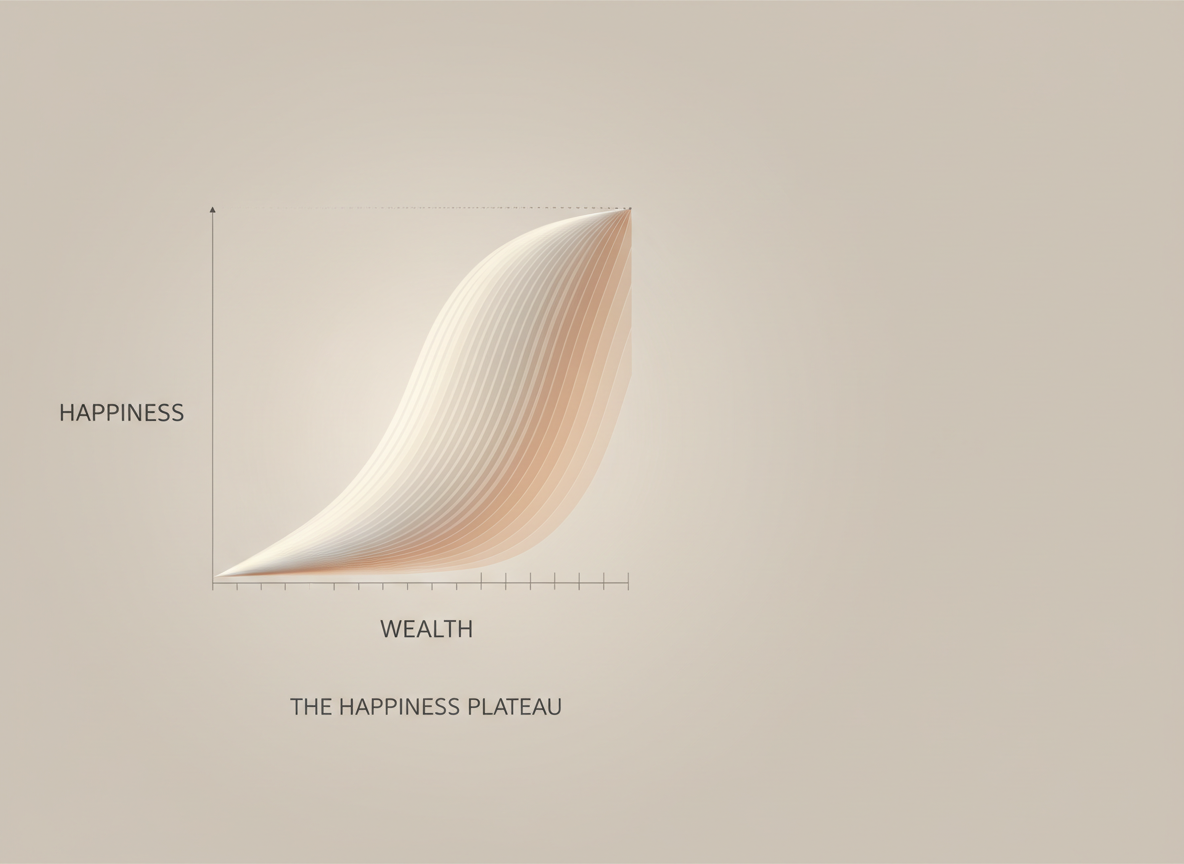
For all the ancient wisdom about wanting less, the modern data are oddly sympathetic. When researchers at Princeton tried to pin down the relationship between money and happiness, they found that beyond a certain point, more income stops doing much for daily emotional life. In their widely cited study, Daniel Kahneman and Angus Deaton estimated that everyday well-being rose with income up to around $75,000 a year in the United States and then largely flattened (Kahneman & Deaton, 2010). A more recent, higher-resolution look by Matthew Killingsworth suggests the plateau is closer to $100,000, but the shape of the curve is the same: the higher you go, the less each extra dollar moves the needle (Killingsworth, 2021).
Psychology has a name for this vanishing thrill: hedonic adaptation. We adjust to improvements with dismaying speed. In a classic study, Philip Brickman and colleagues compared recent lottery winners with ordinary people. Within a year, the winners were not vastly happier; in some ways their day-to-day pleasures had even dulled, their extraordinary good fortune absorbed into a new normal (Brickman et al., 1978). Later work by Ed Diener, Richard Lucas, and Christie Scollon complicated the story—not everything is equally easy to adapt to, and some changes have more durable emotional impact than others—but the basic treadmill remains (Diener, Lucas & Scollon, 2006). Life upgrades, we sprint for a while, and then we find ourselves back at baseline, scanning the horizon for the next finish line.
The uncomfortable implication is that what matters for well-being is not simply how much you have, but how what you have compares to what you think you need. Several studies now point to what researchers call a “financial desire discrepancy”: the gap between your current resources and the level of wealth you believe would finally feel like enough. That gap, it turns out, is a stronger predictor of life satisfaction than your absolute income or net worth. A household earning modestly but feeling close to its “enough” can be emotionally better off than a far richer one that is convinced it is still behind.
Even the most dramatic financial windfalls have less power than our fantasies give them credit for. Following British lottery winners for years, economists Andrew Oswald and Jonathan Gardner found that the winners did become a bit more satisfied with their lives, but the shifts in mental health were surprisingly modest given the scale of the sums involved (Gardner & Oswald, 2007). When other teams have looked at inheritances or sudden asset gains, the pattern holds: large jumps in wealth produce only small, often short-lived improvements in psychological well-being.
Taken together, these findings don’t say that money doesn’t matter. Below a certain threshold, it matters a great deal; financial strain is corrosive. But past the point where your basic needs and a modest buffer are covered, the lever that moves happiness is less about piling up more and more, and more about closing the perceived distance between your life and your idea of “enough.” Contentment, in other words, is not a sentimental add-on to financial planning; it is one of the variables.
If that is true, the practical stakes are enormous. A person who can genuinely live well on less does not just feel calmer; they need a smaller “enough number”—a lower savings target to reach financial independence. Their required retirement account is smaller, their debt tolerance is lower, their vulnerability to layoffs and downturns shrinks. In the language of spreadsheets, contentment compresses your liabilities. It means you can step off the treadmill earlier, or at least slow it down to a human pace.

Putting Contentment to Work: Practical Financial Guidance

Join the Conversation
Where is your own “enough” line, and what did it take to find it? Has your definition of wealth shifted over time, perhaps in ways that surprised you? What’s one thing you once thought you needed—a status symbol, a luxury, an escape hatch—that you’ve since learned to let go of, and what filled that space instead? I’d love to hear your thoughts and reflections in the comments below.
Define Your “Enough Number”. If contentment is a kind of wealth, your financial life still needs numbers. One of the simplest, and most sobering, is the FIRE movement’s “25x rule”: estimate how much you would like to spend in a year, then multiply by twenty-five to get a rough target for financial independence. If you can live well on $40,000 a year, your finish line is around $1 million. If you feel you need $80,000, it jumps to $2 million. The math is blunt: when your inner sense of “enough” shrinks, the mountain in front of you shrinks with it. Contentment doesn’t just make today feel easier; it literally halves the distance to the horizon.

Fight Lifestyle Inflation Deliberately. In most careers, income doesn’t jump so much as creep. Almost without noticing, our expenses creep to match it. Psychologists call this lifestyle inflation; it feels like standing still on a moving walkway. A bigger salary quietly becomes a higher baseline for groceries, trips, rent, upgrades. One way contentment shows up in a spreadsheet is by interrupting that autopilot. When your pay rises, you can decide in advance that the extra money never quite reaches your day-to-day life: increase your retirement contribution, automate a transfer to savings, direct the new dollars toward debt. The raise you never see is the raise you never spend, and over a decade that invisible discipline can matter far more than any single big financial win.
The 50/30/20 Budget Reframed Through Contentment. A common rule of thumb says that roughly half your take-home pay goes to needs, thirty percent to wants, and twenty percent to saving or paying down debt. It’s a tidy framework, but contentment complicates the middle slice. If you are serious about wanting less, the thirty percent earmarked for “wants” is not a guilt-free playground; it is a field study. What in that category actually makes your days feel richer, and what simply keeps you in step with other people’s expectations? A dinner with a friend might belong there proudly; a third streaming service you barely touch probably does not. Over time, this reframing bends the whole budget: the wants that genuinely nourish you stay; the ones that were just noise make room for faster progress toward your enough number.

The Mindful Spending Audit. To find those fault lines, you need data that is not just numerical but emotional. For thirty days, keep living your ordinary life, but tag every discretionary purchase—every non-necessity—with one of three labels: “Added joy,” “Neutral,” or “Regret.” A coffee with a colleague that left you energized may qualify as joy. The late-night online order that arrived and immediately felt like clutter goes straight to regret. Most people discover, with a small shock, that thirty to forty percent of their discretionary spending lives in the Neutral-to-Regret zone. Contentment gives you permission to treat that portion as optional. Trimming only those forgettable or actively irritating outlays can free up hundreds of dollars a month, without feeling like austerity, because you are cutting what your own experience has already marked as empty.

Contentment as a Debt-Reduction Accelerator. Debt is not only a math problem; it is often a story about desire. In the United States, the average household carries thousands of dollars in credit card balances, much of it traced back to lifestyle upgrades and social comparison spending rather than bare survival. A contented person is not magically immune to temptation, but their appetite is quieter. They feel less urgency to use tomorrow’s money to fund today’s image. That shift matters. When you stop leasing your self-worth, interest charges lose some of their grip. You can redirect extra cash from that Mindful Spending Audit toward balances, watch them fall faster, and feel your future monthly obligations loosen. Lower desire becomes lower debt load, which in turn becomes lower background stress—another dividend of wanting less.
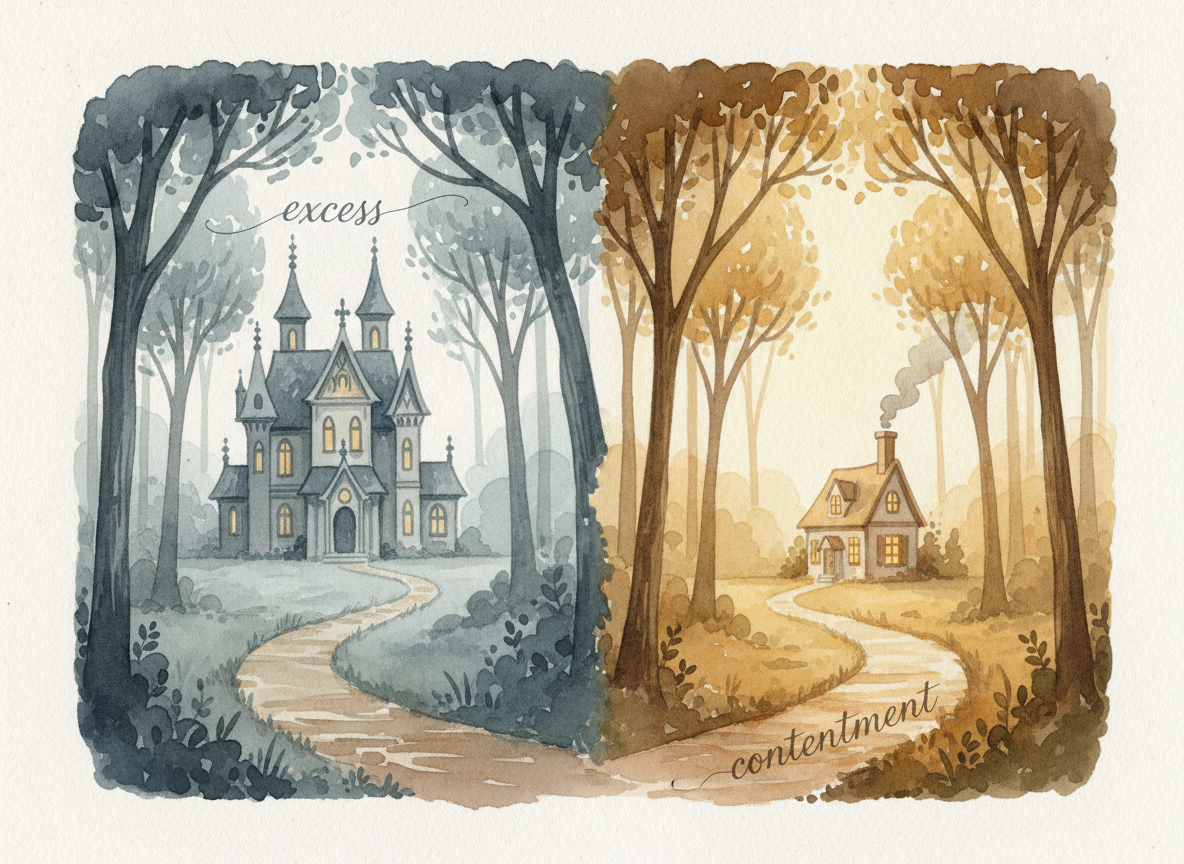
The Retirement Math of Wanting Less. Within the FIRE community there is a quiet debate between “Lean FIRE” and “Fat FIRE.” Lean FIRE imagines a stripped-down, low-cost life; Fat FIRE assumes a more expansive, expensive version. Neither is morally superior. The question beneath them is simple: how much do you actually need to feel that your life is full? Contentment doesn’t demand that you choose the leanest possible script, but it widens the range of answers that would feel acceptable. A person at ease with a simpler life can reach their enough number years earlier, or step into part-time work, or trade a prestigious job for one that matters more. A person who needs every bell and whistle may work much longer to buy the same sense of sufficiency. In that light, learning to want less is not a retreat from ambition; it is a way of reclaiming time, risk, and possibility—wealth measured in options, not just in dollars.

Contentment Is Not Complacency
There is a trap here, and it is worth naming. Talking about contentment can easily turn into a way of telling people to put up with situations that are unfair or unsafe. Be grateful, we say, as though gratitude were a substitute for agency. That is not what the Stoics meant, not what the Buddhists meant, and not what a sane modern life requires.
Real contentment does not mean you shrug at injustice or abandon ambition. It does not ask you to make peace with abuse, discrimination, or poverty wages. Those are problems to be challenged and changed, not spiritually reframed until they hurt less. The point is not to lower your standards for what humans deserve.
Instead, contentment changes the terms of your striving. You can still want to grow, build, and create, but you are not wagering your basic okayness on the outcome. Ambition becomes an expression of who you are rather than a desperate attempt to prove something. You move because you are full enough to be generous, not because you are empty and need the world to fill you.
The Quiet Recalculation
If you take this seriously, it quietly reorders the math of your life. Instead of asking only, “How can I earn more?” you begin to ask, “How can I need less without feeling like I am shrinking my life?” That question leads not to asceticism, but to a kind of intentionality. Which desires actually taste good when you fulfill them, and which only make you hungrier?
You might notice that a walk with a friend lingers in your memory long after a hurried purchase is forgotten. That an afternoon spent absorbed in something you love feels richer than an hour scrolling through what other people own. That sleeping well because your expenses don’t terrify you is its own kind of luxury.
There is nothing inherently virtuous about having less, just as there is nothing inherently corrupting about having more. The question is whether you are free. Can you savor what is here without immediately converting it into a stepping stone to something else? Can you let some things alone and feel, in doing so, not deprived but quietly rich?
In the end, contentment may be the kind of wealth that cannot be taken by a market crash, a layoff, or a twist of fate. It is portable, compounding, and strangely subversive in a culture that profits from your restlessness. You can start to build it without anyone’s permission, in the middle of the life you already have, by the simple, difficult act of noticing what is already enough.
And if, the next time someone asks whether you want to be wealthier, you pause before answering, it may be because you’ve realized that some forms of wealth are measured not in more, but in finally having, for once, just enough.
About the Author
R. Lee Farrow
R. Lee Farrow is the author of the V.O. Family Book Series, an Army Veteran, and a dedicated patron of her community. |
Editor: F. Farrow-Matthews


Leave a comment